

Tarde, an unfinished DIY experiment
Tarde is a bimonthly experimental publication that explores the often-unnoticed associations, encounters, and frictions that shape urban life. Moving across anthropology, design, digital journalism, visual culture, more-than-human approaches, and philosophy, it pays attention to the minor events and everyday intensities through which public spaces are constantly made, used, contested, and transformed.
Inspired by DIY culture, punk fanzines, guerrilla publishing, and the self-publishing possibilities opened by digital media, Tarde focuses on a single topic, case, or urban situation in each issue. Rather than offering a closed explanation, each edition works as a small field device: a folded object that combines different formats, narratives, materials, ethnographic vignettes, visual essays, and data visualizations. Its pages emerge from walking, observing, collecting, registering, and exhausting the world outside.
Tarde is unfinished by design. It is a publication, but also a method, a rehearsal, and a portable archive of urban attention. Each issue experiments with how research can circulate beyond academic formats, how small observations can become public arguments, and how print can still operate as a modest but powerful infrastructure for noticing the city differently.
A collection of minor ethnographic stories
The idea of producing minor ethnographic stories draws on what Gilles Deleuze and Félix Guattari described as minor literature: “a political literature of minorities[1].” For them, the minor does not simply refer to something small or marginal. It names a way of working from the edges of dominant languages, formats, and institutions to make other forms of expression, attention, and politics possible.
In the case of Tarde, minor ethnographic stories are not grand narratives about the city. They are situated fragments, partial accounts, small scenes, overlooked gestures, material traces, and everyday encounters that reveal how urban life is continuously assembled. They pay attention to what is often ignored: street objects, informal practices, atmospheric conditions, improvised uses, nonhuman presences, infrastructures, and the people whose routines quietly sustain the city. This minor approach has three implications.
- It experiments with a deterritorialized language that challenges the conventions of mainstream academic writing and opens space for other forms of description, narration, and visual argument.
- It insists on the political force of the unnoticed, treating minor actors and situations as constitutive rather than secondary elements of urban life.
- It understands publication as a collective and collaborative process: an unfinished attempt to include, listen to, and work with the people, materials, and more-than-human presences that shape the city Tarde seeks to describe.
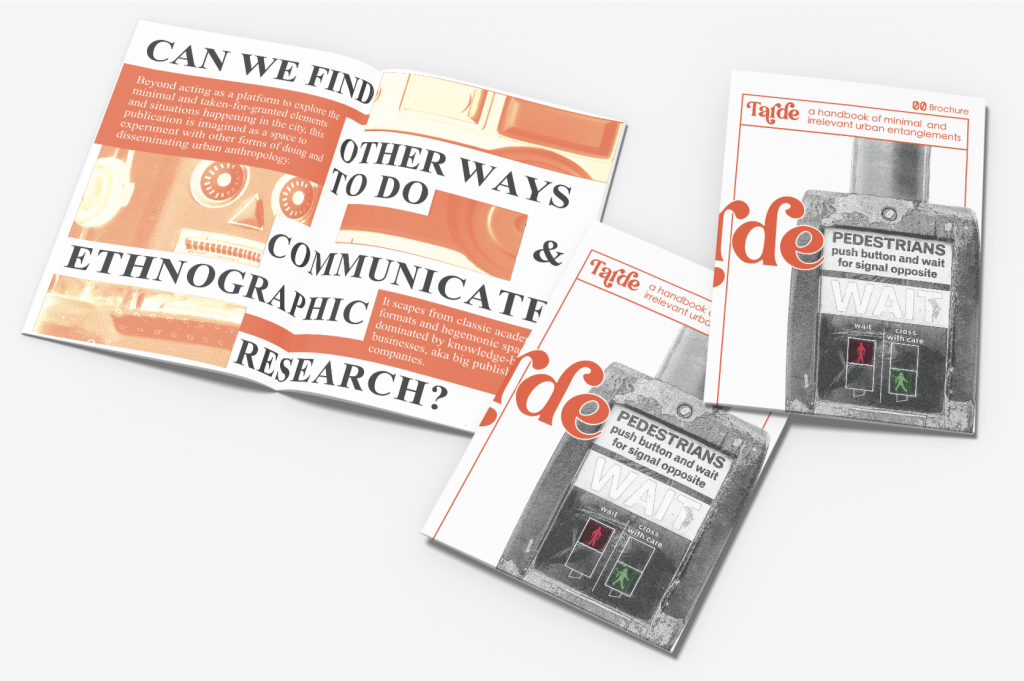
Can we find other ways to do and communicate ethnographic research?
Although Tarde is conceived as a self-published publication, each issue is curated and discussed with guest scholars, artists, designers, journalists, and practitioners to ensure careful, rigorous, and situated content. The handbook also has a digital extension—this website—where printed materials can be expanded, complemented, and reactivated through additional references, images, notes, and resources. At the same time, people from anywhere in the world can download, print, fold, and distribute each issue under a Creative Commons Attribution-NonCommercial license.
Beyond serving as a platform for exploring the minimal, ordinary, and often taken-for-granted situations that shape urban life, Tarde is imagined as a space for experimenting with other ways of doing and sharing urban anthropology. It moves away from conventional academic formats and from the hegemonic spaces of knowledge circulation dominated by large publishing companies. Instead, it asks what ethnographic research can become when it is folded, carried, printed at home, shared by hand, read in public, or used as a small device for noticing the city differently.
In doing so, Tarde proposes an open-access, collaborative, and inventive hybrid artifact: part publication, part fieldwork device, part archive, part visual essay. It has both a physical and online presence, but it remains modest, portable, and easy to reproduce. It is a collectible document that can travel across classrooms, workshops, streets, libraries, and everyday conversations. Whether you are an academic, a student, a practitioner, or simply curious about urban life, Tarde offers an invitation to look again, to notice more carefully, and to imagine ethnography as something that can be made, shared, and inhabited otherwise.
Ethnography as an inventive machine
Expanding Andrea Ballestero and Brit Ross Winthereik’s attention to the imaginative force of analytic practices in ethnography, Tarde connects crafting and designing methods with “a form of [ethnographic] knowledge production” and with the “creative and organized process of generating insights” [2] in urban research.
The project also works as an entangled, experimental, and interdisciplinary hub for inventive, sensory, and multimodal methodologies across printed and online media. Two main sources of inspiration guide this aim:

1. Tarde follows Sarah Pink’s [3] understanding of multisensory ethnography as an interconnected set of sensory relations that exceeds individual modalities, fixed categories, and disciplinary boundaries.
2. Continuing this interdisciplinary orientation, the handbook draws on Celia Lury and Nina Wakeford’s [4] explorations of methodological inventiveness, especially their attention to ethnographic practice through epistemological devices and material artifacts.
Why Tarde?
Tarde is named after Gabriel Tarde (1843–1904), a French sociologist whose work on social interaction, singularity, imitation, and variation can also be understood as “minor.” His contributions were largely displaced from mainstream sociology after being overshadowed by Émile Durkheim’s conception of society as the stabilization of well-defined macrostructures.
The handbook takes Gabriel Tarde’s invitation to analyze the world by paying attention to small social interactions and extends it toward the encounters, materials, gestures, situations, and urban elements that are often ignored. For Tarde, these small interactions produced open, temporary, and unstable networks that, when connected, composed larger social formations. This is also how Tarde understands the urban: not as a fixed container, but as an assemblage of minor encounters constantly being made and remade.
As a final note, Gabriel Tarde’s work strongly influenced Deleuze’s philosophy, particularly his thinking on repetition, difference, and assemblage. It also played an important role in Bruno Latour’s notion of association as an alternative to conventional concepts of society. In this sense, Tarde has often been considered a precursor of Actor-Network Theory, an epistemological approach that this project takes as one of its main workbenches.
References
[1] Deleuze, G. and Guattari, F. (1986). Kafka: Toward a Minor Literature. Minneapolis: University of Minnesota Press. p. 66.
[2] Ballestero, A. And Wintherrek, B. (Eds.). (2021). Experimenting with Ethnography: A Companion to Analysis. Durham: Duke University Press.
[3] Pink, S. (2009). Doing Sensory Ethnography. London: SAGE Publications.
[4] Lury, C. and Wakeford, N. (2012). Inventive Methods: The Happening of the Social. London: Routledge.